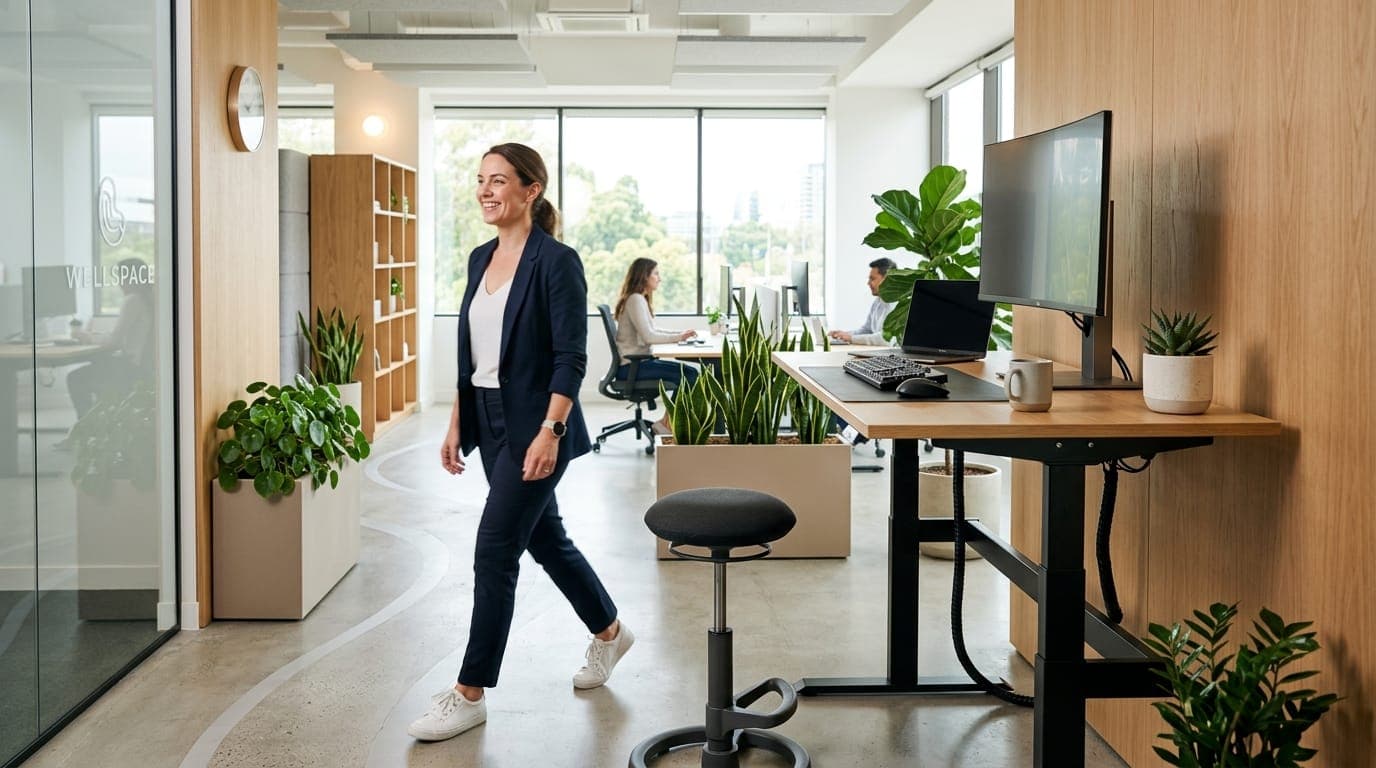
You are shopping for a better chair, or a keyboard that stops your wrist aching, or one of those desks that goes up and down. That is a reasonable thing to be doing, and this post is not going to tell you it is a waste of money.
But it is worth being precise about what you are buying, because sitting at a desk all day creates two separate problems, and ergonomic equipment only addresses one of them.
- Problem one: load. Your wrist is bent at an angle for seven hours. Your neck is craned forward. Your lower back is unsupported. This causes strain, pain, and sometimes injury — and it is exactly what good equipment is designed to fix.
- Problem two: stillness. Your body has been in roughly one position, with your large muscles doing nothing, since 9 AM. This has effects a chair cannot touch, because the chair is not what is wrong.
Buy the good chair. Then read the rest of this, because the chair is going to make you more comfortable sitting still, and comfort is not the same as health.
Quick Answer: Gear vs. Movement
- Ergonomic equipment fixes posture and load — wrist angle, neck position, lumbar support. This is real, and worth spending money on if something hurts.
- It does not fix inactivity. The metabolic and circulatory effects of long sitting come from muscles not contracting, not from how your spine is aligned.
- Standing is not movement. When they were compared directly, short light walking breaks beat standing substantially for post-meal glucose and insulin.
- There is a comfort trap. The thing that used to make you get up was discomfort. Remove it and sitting bouts get longer.
- The effective dose is small — a few minutes of walking every half hour, which no piece of furniture can do for you.
Table of contents
- Two problems that look like one
- What ergonomic equipment genuinely does
- What it cannot do, and why
- The comfort trap
- Standing desks: a partial upgrade
- The dose of movement that actually matters
- Designing a desk setup that makes you move
- How to tell whether any of it is working
- Frequently asked questions
- Key takeaways
Two problems that look like one
Both problems come from the same workday, which is why they get bundled together in the phrase "sitting is bad for you." But they have different mechanisms and different solutions.
| What you notice | What is actually causing it | What fixes it |
|---|---|---|
| Wrist ache, tingling fingers | Sustained awkward wrist angle, repetitive load | Equipment — keyboard position, wrist support, mouse shape |
| Neck and shoulder tension | Monitor too low, shoulders hunched, no arm support | Equipment — monitor height, chair arms, desk height |
| Lower back pain | Unsupported lumbar curve, slumped posture, plus hours without position change | Both — support and changing position regularly |
| Stiff hips, general creakiness | Staying in one position for hours | Movement — equipment barely helps |
| Afternoon energy crash, heavy legs | Prolonged inactivity, pooling circulation | Movement — equipment does not help |
| Longer-term metabolic risk | Large muscles not contracting for hours at a time | Movement — equipment does not help |
Read down the right-hand column and the split is clear. The top of the list is a hardware problem. The bottom is a behaviour problem. Most people buy hardware and hope it covers both.
Sedentary time is in fact associated with musculoskeletal pain, particularly in the lower back and neck,1 so there is genuine overlap in the middle of that table — a well-supported spine and regular position changes both matter for back pain. But the bottom rows do not move at all in response to furniture.
What ergonomic equipment genuinely does
To be unambiguous, because this is where the money goes and it is not wasted:
- A chair with real lumbar support and adjustable arms keeps your spine in a neutral position and takes load off your shoulders. If your current chair is a dining chair or a sagging office castoff, this is the highest-value purchase on the list.
- Monitor at eye height stops the forward neck craning that produces the classic end-of-day headache. A stack of books does this for free.
- Keyboard and mouse placement — forearms roughly parallel to the floor, wrists straight rather than bent up — is what reduces sustained strain on the wrist. The placement matters more than the gadget; a wrist rest used as a place to rest between bursts of typing helps, while one you press into while typing can increase pressure.
- A footrest matters if your feet do not sit flat, which quietly changes how your pelvis and lower back are loaded.
If something hurts right now, fix the setup first. Pain is a stronger barrier to movement than laziness is, and you will not take a walk at 3 PM if your back is seizing.
One honest caveat: the marketing around some of this gear runs well ahead of the evidence, particularly for devices sold as preventing conditions like carpal tunnel syndrome. Good positioning is well supported; the specific accessory is often less proven than the box implies. Buy for the comfort you can feel, not the condition you hope to avoid.
What it cannot do, and why
Here is the mechanism that no chair addresses.
When you sit still, the large muscles of your legs and hips essentially switch off. They are not contracting, and muscle contraction is what drives a lot of what happens next: glucose uptake from the blood, the activity of enzymes involved in clearing fats from circulation, and the simple mechanical pumping that keeps blood moving in your legs. Prolonged inactivity suppresses that machinery, and the effect is specific to inactivity rather than to posture.2
This is why the research on breaking up sitting is about breaking it up rather than about sitting better. In a randomised crossover trial of five different break patterns, five minutes of light walking every 30 minutes produced the largest reductions in post-meal glucose and blood pressure compared with uninterrupted sitting.3 Nobody in that study changed chairs.
It is also why a long sitting day is not fully cancelled by a gym session, though a very active day helps considerably — a harmonised meta-analysis of over a million people found that high levels of daily activity attenuated the mortality risk associated with long sitting, rather than there being no relationship at all.4 The honest summary is that both matter, and that the hours between workouts are not neutral.
The comfort trap
This is the part that gets skipped, and it is the reason this post exists.
Think about what actually makes you stand up during a workday. Usually, it is discomfort. A numb leg. A stiff back. Shifting in your seat for the fifth time. Discomfort is a crude, annoying, and rather effective timer.
Now make the chair excellent. Add lumbar support, a footrest, armrests at exactly the right height. What happens to that timer?
It stops going off. A genuinely comfortable setup removes the signal that used to interrupt you, and sitting bouts get longer. People who invest in a good setup often find they now sit for three hours without noticing, where previously they could not manage ninety minutes.
That is not an argument for a bad chair. It is an argument for replacing the crude timer with a deliberate one, at the same time as you upgrade the chair. If you remove the thing that used to prompt you to move and put nothing in its place, the upgrade has made your posture better and your day more sedentary.
Standing desks: a partial upgrade
Standing desks occupy a confusing middle position, so it is worth being precise.
What they do well: they change your position, which is genuinely valuable — a day split between sitting and standing involves more variety of load than a day in one chair. They also lower the barrier to movement. It is much easier to step away from a desk you are already standing at than to get up out of a chair.
What they do less well than advertised: standing on its own is a weak substitute for moving. In a meta-analysis that compared prolonged sitting against standing breaks and against short light walking breaks, walking lowered post-meal glucose and insulin substantially more than standing did.5 Standing up satisfies the instinct to do something; it does not contract much muscle.
And they have their own costs. Prolonged standing is not free — it brings leg discomfort, foot pain, and lower-back fatigue of its own. The goal is not to replace eight hours of sitting with eight hours of standing.
The useful way to think about a standing desk: it is a position-changing tool, not an exercise tool. Its best feature is that it makes the next step — actually walking away — easier.
The dose of movement that actually matters
The reassuring part of this research is how small the effective dose is.
| Interval | What it looks like | What the evidence suggests |
|---|---|---|
| Every ~30 minutes | 2–5 minutes of light walking | The pattern with the clearest benefit for post-meal glucose and blood pressure3 |
| After meals | 10–15 minutes, starting within half an hour | Lowers post-meal glucose more than the same walking at another time — see walking after meals |
| Across the day | Accumulated steps | The health curve bends sharply between about 5,000 and 7,000 steps a day |
None of that requires gym clothes, a shower, or a block in your calendar. It requires leaving your desk, which is precisely the thing a more comfortable desk makes less likely.
Designing a desk setup that makes you move
Ergonomics usually means removing friction. For the movement half of the problem, you want to add a little back:
- Put the thing you need often slightly out of reach. A water glass instead of a litre bottle means refills. A printer on a different floor is a feature.
- Take calls walking. Audio-only calls are the single biggest source of free steps in an office day. A corridor or a pavement works.
- Make one daily trip deliberately inefficient. The far bathroom, the next coffee shop, the long way to the meeting room.
- Use the standing desk as a staging post, not a destination. Stand up, then leave. Standing at the desk is the halfway house; the walk is the point.
- Pair movement with something you already do — the end of a meeting, sending a report, finishing lunch. Habits attach to events more reliably than to clock times.
- Fix the pain first. If your wrist or back hurts, sort the equipment. Then add the movement. In that order.
How to tell whether any of it is working
Comfort you can feel immediately. Movement you cannot — which is why it needs measuring.
Steps are the easiest available proxy. Not because step count is a perfect measure of health, but because it is the one number that reflects whether you actually left the chair, and it is already being counted by the phone on your desk.
What is worth watching is not the daily total so much as the shape: a day with 8,000 steps taken entirely in one evening walk is a day you still sat for nine hours straight. A day with the same total spread across a dozen trips is a different day physiologically, even though the number matches.
This is also where a forecast beats a tally. Steps Widget projects where your day is heading from your own history and only speaks up when that projection falls short — in the afternoon, while there are still hours to act, rather than at 10 PM when the information is useless. It is deliberately not an hourly timer, because a reminder that fires whether or not you have moved is a reminder you will mute within a week. The reasoning is in why hourly stand up reminders fail.
Buy the chair. Fix the monitor height. Then put something in place of the discomfort you just engineered away.
Frequently asked questions
Is an ergonomic chair worth it? For posture, comfort, and musculoskeletal strain, yes — particularly if something currently hurts. It will not reduce the metabolic effects of sitting for long stretches, because those come from muscles not contracting rather than from how you are supported.
Does a standing desk cancel out sitting all day? No. Standing is better than sitting for position variety, but when standing and light walking were compared directly, walking lowered post-meal glucose and insulin substantially more. A standing desk's best feature is making it easier to walk away.
Do wrist rests prevent carpal tunnel syndrome? The evidence for specific accessories preventing carpal tunnel is weaker than the marketing suggests. Keyboard and mouse positioning — forearms level, wrists straight — is better supported. A wrist rest is best used as somewhere to rest between bursts of typing rather than something you press into while typing.
How often should I get up from my desk? Roughly every 30 minutes, for a few minutes of light walking. In a randomised crossover trial, five minutes of walking every half hour produced the largest improvements in post-meal glucose and blood pressure.
If I exercise after work, does the sitting still matter? It matters less, but it still matters. A meta-analysis of over a million people found high daily activity substantially attenuated the risk associated with long sitting — attenuated, not erased. The hours between workouts are not neutral.
Can good ergonomics make me sit more? Yes, and it is a real effect worth planning for. Discomfort is what usually prompts people to stand up. Remove it without replacing it and sitting bouts get longer.
Key takeaways
| Question | The short answer |
|---|---|
| What does ergonomic gear fix? | Load and posture — wrist angle, neck position, lumbar support |
| What does it not fix? | Inactivity, which comes from muscles not contracting |
| Is a standing desk enough? | No — walking beat standing clearly in direct comparison |
| What is the catch with a great setup? | It removes the discomfort that used to make you get up |
| What is the effective dose? | A few minutes of light walking every half hour |
| How do I know it is working? | Watch the shape of your step count, not just the total |
Related reading: what sitting all day does to your body for the evidence in full, you sit longer than you realize on how badly people estimate their own sitting, and walking after meals for the highest-value ten minutes in the day.
References
-
Dzakpasu FQS, Carver A, Brakenridge CJ, et al. Musculoskeletal pain and sedentary behaviour in occupational and non-occupational settings: a systematic review with meta-analysis. International Journal of Behavioral Nutrition and Physical Activity. 2021;18(1):159. doi:10.1186/s12966-021-01191-y ↩
-
Hamilton MT, Hamilton DG, Zderic TW. Exercise physiology versus inactivity physiology: an essential concept for understanding lipoprotein lipase regulation. Exercise and Sport Sciences Reviews. 2004;32(4):161–166. doi:10.1097/00003677-200410000-00007 ↩
-
Duran AT, Friel CP, Serafini MA, Ensari I, Cheung YK, Diaz KM. Breaking up prolonged sitting to improve cardiometabolic risk: dose–response analysis of a randomized crossover trial. Medicine & Science in Sports & Exercise. 2023;55(5):847–855. doi:10.1249/MSS.0000000000003109 ↩ ↩2
-
Ekelund U, Steene-Johannessen J, Brown WJ, et al. Does physical activity attenuate, or even eliminate, the detrimental association of sitting time with mortality? A harmonised meta-analysis of data from more than 1 million men and women. The Lancet. 2016;388(10051):1302–1310. doi:10.1016/S0140-6736(16)30370-1 ↩
-
Buffey AJ, Herring MP, Langley CK, Donnelly AE, Carson BP. The acute effects of interrupting prolonged sitting time in adults with standing and light-intensity walking on biomarkers of cardiometabolic health in adults: a systematic review and meta-analysis. Sports Medicine. 2022;52(8):1765–1787. doi:10.1007/s40279-022-01649-4 ↩
Recommended posts
Try Steps Widget
Keep your daily steps visible on iPhone, Lock Screen, Home Screen, and Apple Watch with a private Apple Health step counter widget.